
Council hard rubbish collections are one of Sydney’s most useful — and most misunderstood — services. Thousands of residents put items out each year only to have them left behind, or worse, receive an infringement notice for dumping prohibited items.
This guide explains exactly how Sydney’s hard rubbish system works, what your council will and won’t collect, and what to do with the items that don’t make the list.
Hard rubbish (also called bulk waste or kerbside clean-up) refers to large household items that are too big for your regular bin. In Sydney, most councils offer residents a free or subsidised collection of these items once or twice a year — you place approved items on the kerb outside your property and a council truck picks them up on a scheduled date.
The name “hard rubbish” comes from its distinction from “green waste” (garden clippings, branches) and general household waste. It’s the furniture, appliances, and broken-down junk that builds up in garages, sheds, and spare rooms over the years.
Unlike Melbourne, where most councils run suburb-wide collections on fixed schedules, Sydney councils largely operate on a request-based or zone-based system. This means you usually need to actively book your collection rather than waiting for a set date.
General steps to book:
Collection limits vary by council. Most Sydney councils allow one collection per property per year, with a maximum volume limit — typically around 3 cubic metres (roughly the size of a large skip bin). Some councils count individual items rather than volume.
Here’s a quick reference for some major Sydney councils:
| Council | System | Booking |
|---|---|---|
| City of Sydney | On-request booking | Council website |
| Inner West Council | On-request, 3m³ limit | Online portal |
| Randwick City Council | Zone-based annual schedule | Check suburb schedule |
| North Sydney Council | On-request booking | Phone or online |
| Parramatta City Council | On-request per household | Council website |
| Blacktown City Council | Annual booked service | Online booking |
| Sutherland Shire Council | On-request booking | Council website |
| Northern Beaches Council | On-request, zone-based | Check council website |
Because collection dates change every year, always check your specific council’s website for the most current information rather than relying on previous years’ dates.
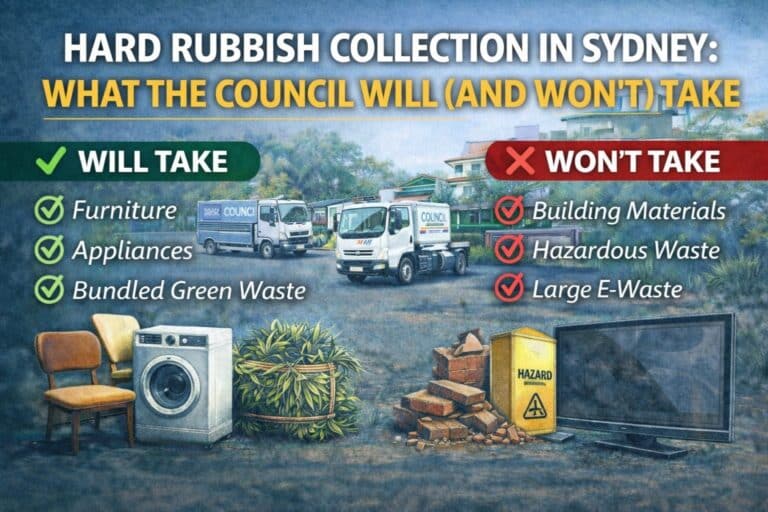
While specifics vary between councils, most Sydney hard rubbish collections accept the following categories of items:
Furniture
Whitegoods and appliances
General household items
Timber and basic building materials (in small quantities)
Electronics
Note that e-waste rules have changed significantly across NSW. Many councils now collect e-waste separately through dedicated drop-off points rather than via hard rubbish trucks, because electronics require specialised recycling. Always check with your council before putting electronics on the kerb.
This is where most people come unstuck. The list of rejected items is longer than most residents expect, and leaving prohibited items on the kerb can result in a fine or the items simply being left behind.
Items almost universally rejected across Sydney councils:
Asbestos and building materials containing asbestos This is the most important one. Fibro sheeting, old roof tiles, and certain floor coverings installed before 1990 may contain asbestos. Councils will not collect these under any circumstances — asbestos requires licensed removal and disposal at a licensed facility. Contact the NSW EPA or a licensed asbestos removalist for guidance.
Mattresses (often) This surprises many people. A large number of Sydney councils have stopped accepting mattresses in standard hard rubbish collections due to the cost and complexity of processing them. Some councils have separate mattress recycling programs; others direct residents to private removal services. Check your council’s specific rules — and if mattresses aren’t accepted, see our guide on [how to dispose of a mattress in Sydney].
Liquid waste Paints, oils, chemicals, cleaning products, and other liquids are never accepted. Many councils run separate hazardous waste drop-off days where these can be disposed of safely and for free.
Car bodies and tyres Vehicles, vehicle parts, and tyres have their own regulated disposal channels. Tyres can be taken to participating retailers or tyre recycling facilities.
Gas bottles LPG cylinders and other pressurised containers are not accepted due to safety risks during compaction. Hardware stores and some service stations offer exchange or return programs.
Construction and renovation waste This is a big one for homeowners mid-renovation. Bricks, concrete, plaster, tiles, fibreglass, and large quantities of timber are almost never accepted in standard hard rubbish collections. These materials require a skip bin, a tip run, or a professional rubbish removal service.
Medical waste and sharps Needles and syringes must go through dedicated sharps disposal programs. Many pharmacies offer free sharps disposal containers.
Commercial quantities of waste Hard rubbish collections are residential services only. Business owners cannot use them for commercial waste, no matter how small the business.
For many Sydney residents, the council collection is the obvious first choice — it’s free, after all. But there are some genuine limitations worth thinking through before you bank on it:
Waiting times can be weeks or months. Some councils only run collections once a year per suburb, meaning if you just missed yours, you could be waiting up to 12 months. Even on-request systems often have 4–8 week lead times during busy periods.
Volume limits mean you can’t clear everything at once. If you’re doing a full garage clearout, renovation cleanout, or deceased estate clearance, the council’s 3 cubic metre limit won’t cover it.
Prohibited items leave you stuck. If half of what you need to get rid of is on the rejected list — renovation rubble, mattresses, old paint — the council collection only solves part of the problem.
Items left on the kerb attract scavengers and pests. Once items are put out, they sit exposed on the kerb until collection day. In wet weather or over extended periods, this can create mess and attract vermin.
None of this means council collections aren’t worth using — they absolutely are, for the right items. But it’s good to go in with clear expectations.
If you have items that fall outside your council’s accepted list, here are your main options:
Tip drop-off (transfer station) Sydney’s waste transfer stations accept most items that councils won’t, including renovation waste, tyres (for a fee), and some hazardous materials. You’ll need a vehicle capable of carrying the load and be prepared to pay a tip fee, which varies by item type and weight. Lucas Heights in the Sutherland Shire and Kimbriki in the Northern Beaches are two of Sydney’s busiest facilities.
Hazardous waste drop-off days Most Sydney councils run periodic free drop-off events for paint, chemicals, batteries, gas bottles, and other hazardous household items. These are usually held a few times a year — check your council’s events calendar.
Charity donation For items in good condition — furniture, appliances, homewares — Salvos, Vinnies, and organisations like Habitat for Humanity ReStores accept donations and sometimes offer free pickup for larger pieces.
Facebook Marketplace and community groups A surprising amount of “rubbish” is genuinely useful to someone else. Old timber, working appliances, outdoor furniture, even bricks and pavers — listing these as free items often results in someone coming to collect them within a day or two.
Professional rubbish removal For everything else — especially renovation waste, mixed loads, prohibited items, or when you simply don’t have time to manage multiple disposal channels — a professional rubbish removal service is the most practical solution. A good removalist will take almost anything (asbestos excepted), sort it appropriately, and recycle as much as possible.
The collection itself is free for most Sydney residents, but there are indirect costs worth knowing about:
| Item | Council Usually Accepts? |
|---|---|
| Sofa / lounge | ✅ Yes |
| Fridge / washing machine | ✅ Yes |
| Mattress | ⚠️ Check your council — often no |
| Television | ✅ Often (check e-waste rules) |
| Renovation rubble / bricks | ❌ No |
| Paint / chemicals | ❌ No (use hazardous waste day) |
| Tyres | ❌ No |
| Gas bottles | ❌ No |
| Asbestos | ❌ Never — use licensed removalist |
| Timber offcuts | ✅ Usually, in small quantities |
| Garden waste / branches | ⚠️ Often separate green waste service |
| Old carpet | ❌ Usually not |
How do I book a council hard rubbish collection in Sydney? Visit your local council’s website and search for “bulk waste” or “kerbside clean-up.” Most Sydney councils now have online booking portals. If you’re unsure which council area you’re in, enter your address at the NSW Government’s council finder tool.
Can I put items out early? Most councils ask that you only put items out the night before or morning of your scheduled collection. Items left out days in advance can attract fines for illegal dumping and create problems for neighbours.
What happens to the items after they’re collected? Council trucks separate items where possible. Metal and whitegoods are often sent to recyclers, timber may be chipped, and general items go to a processing facility. However, council recycling rates for hard rubbish are generally lower than those of specialist removal companies, which sort loads more carefully.
Can Amigo Rubbish Removal take things the council won’t? Yes — in most cases. We take renovation waste, carpets, mixed loads, mattresses, old timber, and general junk that councils typically reject. The main exception is asbestos, which requires a licensed asbestos removalist under NSW law. Call us on 0433 539 877 and we’ll let you know upfront what we can take.
How much does professional rubbish removal cost compared to using the council? The council collection is free but limited in volume and item types, and requires waiting. Professional rubbish removal in Sydney typically starts around $150–$200 for a small load and scales up from there. For a full garage or house clearout, it’s often cheaper and faster than combining a council collection, multiple tip runs, and separate recycling drop-offs.
What if I’m not home on collection day? As long as approved items are on the kerb before the truck arrives, you don’t need to be home. Most collections happen during business hours, but the exact time varies. Don’t put items out the day before unless your council specifically allows it.
If your upcoming cleanout includes renovation rubble, mattresses, old carpet, or a mixed load of household junk that exceeds the council’s limits — Amigo Rubbish Removal can help. We service all of Sydney seven days a week, handle almost any type of household or commercial waste, and recycle as much as possible.
Call 0433 539 877 or get a free quote online — same-day service is often available.


Copyright 2026 Amigo Rubbish Removal – Proudly Designed and Hosted by BSharp Tech